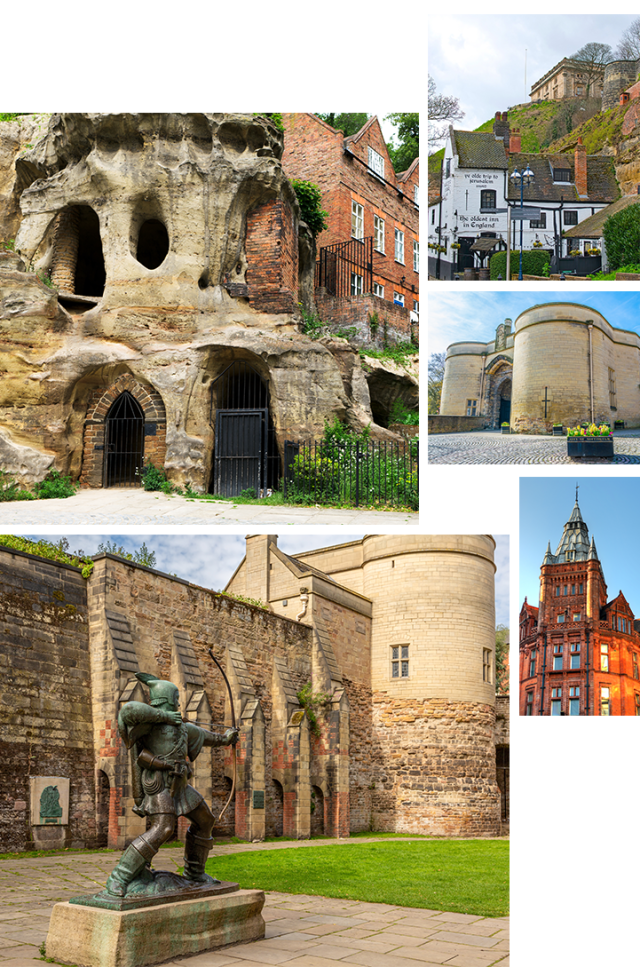
For a manufacturing city that rapidly developed during the Industrial Revolution, Nottingham is unique in having an equally rich pre-industrial history dating back 1,000 years, originally known as Snotengaham back in the 6th century.
Nottingham Castle
Nottingham Castle was constructed shortly after William the Conqueror's invasion, initially starting as a wooden motte-and-bailey structure. Over the centuries, it has witnessed pivotal events, from Richard the Lionheart's battle with his brother John to its partial burning during the 1831 Reform Bill riots.
Following its recent £31m redevelopment, Nottingham Castle offers engaging activities for visitors of all ages, including its museum, galleries, exhibitions, and cave tours.
City of Caves
Also known as the City of Caves, Nottingham's numerous caverns have long been a defining feature of the region, with the city referred to as Tig Guocobauc (House of Caves) in Welsh Anglo-Saxon as early as the 9th century.
Boasting over 800 today, it remains the city with the most manmade caves and over the centuries they have served countless purposes, from hosting the plotting of Edward II's death to functioning as tanneries during the Industrial Revolution, as well as acting as air raid shelters during WWII.
Despite most of the caves being privately owned, several tours are available, each offering unique experiences that highlight the diverse uses of these caverns.
Industrial Expansion
During the Industrial Revolution, as the demand for lace increased, Nottingham became a leading hub for lace production due to its pioneering industrial innovations and skilled workforce.
However, the city faced severe overcrowding within its constricting medieval layout, housing some of Europe's worst slums where diseases were rampant and residents often resorted to living in the caves. Conditions slowly began to improve when public health reforms and urban redevelopment efforts came into play across the mid to late 1800’s.