




Key takeaways
- Auctions support the circular economy by providing a platform for the sale of second-hand products.
- Extending product lifecycles conserves resources and can reduce carbon emissions and landfill waste.
- Auctions give vendors a clear closing date, and give buyers quick acquisitions and the potential to buy below market value.
- Our online auctions cover consumer goods, electrical equipment, commercial vehicles, and industrial plant machinery.
Giving business assets a second life
The longstanding conventional benefits of selling at auctions isn’t a new concept: the ability to generate revenue and minimise costs through selling excess assets is simple and effective for the buyer as well as the vendor.
Auctions provide vendors with a clear time and date in closing a sale offering them a structured and organised approach to selling their goods. Meanwhile buyers can benefit from quick acquisitions and the potential to purchase items below market value.
However, with the societal shift towards fostering a greener economy, auctions are increasingly being recognised for promoting sustainability and advancing the circular economy.
Understanding the circular economy

Historically, products follow a linear lifecycle, known as the ‘cradle-to-grave’ or ‘take-make-dispose’ model. Ultimately, items finish their lifecycle in landfills or incinerators, harming the environment through toxic emissions.
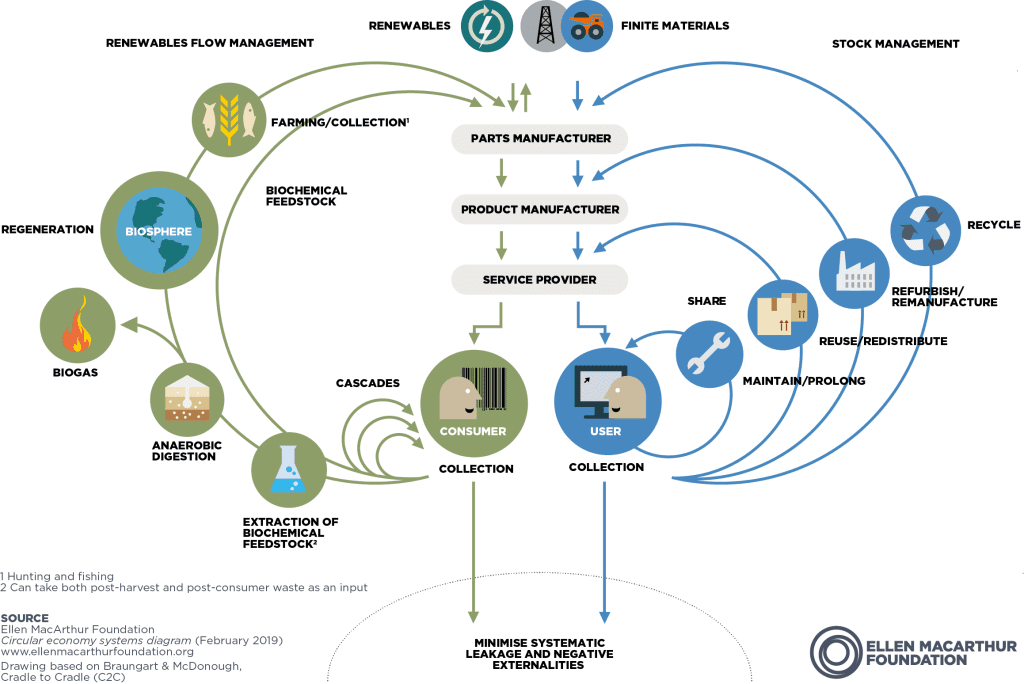
By contrast, the circular economy shifts away from this model, embracing a ‘cradle-to-cradle’ or ‘make-use-recycle’ approach. Here, products are viewed as valuable resources to be continuously recycled back into the economy, prolonging their lifecycle.
While bio-based products participate in the ‘biological cycle’, returning to the earth through practices like composting, technological goods engage in the ‘technical cycle’. In this process, products are shared, maintained, reused, remanufactured, and recycled, with the outer rings signifying more intensive efforts to extend the product lifespan.
By ensuring products maintain value and utility over multiple lifecycles, the circular economy promotes resource efficiency and overall sustainability.
The role of auctions in promoting sustainability and the circular economy
Fundamentally, auctions facilitate the reuse, recycling, and repurposing of goods by providing a platform for the sale of second-hand products. The items’ lifecycle subsequently can be altered, extended, and even infinitely ‘closed’.
Therefore, auctions can positively benefit the environment by:
- Extending product lifecycles
- Conserving energy and resources by mitigating the need to manufacture new products
- Reducing carbon emissions
- Reducing landfill waste
- Promoting resource efficiency and encouraging sustainable consumption
- Driving sustainable solutions through innovation and technology
Turn your surplus assets into revenue
We value and sell assets for commercial businesses and multinational corporations worldwide through online auctions, bringing a changemaker mentality to every sale, so surplus assets can go on to a new owner and a longer life. Our online auction platform features a diverse array of items spanning various sectors, including consumer goods, electrical equipment, commercial vehicles, and industrial plant machinery.
Explore our live online auctions on our website here, from hairdressing equipment and virtual reality gaming simulators to electric forklift trucks.
You can also read our case studies to find out more about our projects. Our latest article delves into our work with Arla Daries, detailing the successful sale of their most complex machinery and assets through auctions and private treaties, following the closure of one of their processing plants.
Get in touch with the BTG Eddisons team
Please contact us for more details and information.